
Years of repression and disappearances have taught Venezuelans, the hard way, not to voice either their anger or their joy, observes Radha Roy Biswas who spent her formative years in Venezuela.

India, the world's fourth largest economy, is set to maintain the 'goldilocks' phase with tailwinds of good growth, low inflation and robust banking performance as well as reform initiatives poised to sustain the economic pace witnessed during 2025.

Well-known inmates of the notorious Metropolitan Detention Center, Brooklyn, New York.

India is evaluating its involvement in the Chabahar port project in Iran due to potential US tariffs. The US had granted India a waiver for the project, but it expires soon. India is exploring options to continue supporting the port's development while minimizing exposure to US sanctions.

A strong performance in the July-September quarter of 2025-26 (FY26) and expectations of growth from launches and acquisition-led synergies led to a 6.65 per cent jump in the share price of Torrent Pharmaceuticals.

Yashasvi Jaiswal: Have selectors told him where he stands in white ball cricket?
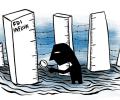
The Centre is regularly holding consultations with stakeholders to streamline foreign direct investments (FDIs) and foreign institutional investments (FIIs) related processes to enable faster and more efficient investment flows into the country, said Commerce and Industry Minister Piyush Goyal, adding one such meeting with stakeholders was held on Tuesday.

'Foreign capital will continue to come directly into India, but companies have realised that GIFT City is a more cost-efficient way of channelling funds.'

'There are times when India should stand up without hesitation and voice its indignation over the US' pressure tactic. This is one such moment,' asserts Ambassador M K Bhadrakumar.

Finance Minister Nirmala Sitharaman on Tuesday asked fintech firms to focus on risk management at a time when criminals are using AI to mimic voices, clone identities and create lifelike videos to manipulate people.

The rupee declined 22 paise to 87.41 against the US dollar in early trade on Thursday after the latest tariff announcements from the US weighed on emerging currencies, including the rupee. Forex traders said the latest tariff announcements from the US have sent shockwaves through global markets, strengthening the dollar.

Congress leader Rahul Gandhi has said the 'wholesale attack on the democratic system' currently underway in India is the single biggest risk the country is facing, and asserted that allowing different traditions to thrive is very important as 'we cannot do what China does, which is to run an authoritarian system'. IMAGE: Kindly note that this image has been posted for representational purposes only. Photograph: / Rediff.com Speaking at a seminar titled 'The Future is Today' at the EIA University in Medellin, Colombia, Gandhi also alleged that there are 'huge amounts of corruption at a centralised level' in India now. "In India, we have huge amounts of corruption now at a very centralised level. So, three or four businesses taking over the whole economy, having a direct relationship with the prime minister, is rampant in India," the Leader of Opposition in Lok Sabha said. "But I believe decentralising power, making things more transparent, bringing people into conversations, and bringing people into processes is the best way forward," Gandhi said while addressing the seminar on Wednesday. Hitting back at the Congress leader for his remarks, the Bharatiya Janata Party on Thursday accused Gandhi of insulting and degrading India on foreign soil. Posting a video clip of Gandhi's speech on X, BJP national spokesperson Gaurav Bhatia said, 'Rahul Gandhi does it again, degrades India on foreign soil. From defaming our democracy in London, to mocking our institutions in the US, now in Colombia he spares no chance to insult Bharat globally.' 'This isn't dissent. It's disgrace to the fake Gandhi. Criticising BJP may be your right but dare you malign Mother India for your cheap and petty politics,' Bhatia said. Speaking at the seminar, Gandhi said India has a much more complex system as compared to China and its strengths are very different from that of the neighbouring country. India also has a very old spiritual tradition and a thought system with profound ideas that are useful in today's world, he said, adding that there is a lot that the country can offer in terms of tradition and way of thinking. "I am very optimistic about India, but at the same time, there are fault lines within the Indian structure. There are risks that India has to overcome. The single-biggest risk is the attack on democracy that is taking place in India," the Leader of Opposition said. "India has multiple religions, traditions and languages. India is actually a conversation between all its people. Different ideas, religions and traditions require space. The best method for creating that space is the democratic system," he said. "Currently, there is a wholesale attack on the democratic system in India, so that is a risk. The other big risk is different conceptions -- some 16-17 different languages, different religions... So, allowing these different traditions to thrive, and giving them space to express themselves is very important for a country like India.

Former White House trade advisor Peter Navarro accuses India of being an 'oil money laundromat' for Russia, alleging that India's oil purchases are funding Putin's war in Ukraine. The accusations come amid existing trade tensions and tariffs imposed by the US.

Gold and silver prices are expected to maintain their upward trajectory this week, but may see late profit-booking amid the release of a series of crucial global economic indicators, analysts said. On the economic front, traders will closely monitor the manufacturing/ services PMI data from across regions and the US non-farm payrolls/ employment data along with consumer confidence for the month of September and speeches from several Federal Reserve officials, they added.

Reserve Bank Governor Sanjay Malhotra on Friday said the exchange rate policy has remained consistent over the years and the central bank does not target any 'specific level or band' of the rupee, which slipped to an all-time low of 87.59 to a US dollar. On Thursday, the rupee plunged 16 paise to close at a record low of 87.59 against the American currency. "I would like to mention here that the Reserve Bank's exchange rate policy has remained consistent over the years.

'America holds about 16% of IMF voting rights, giving it crucial influence over Pakistan's desperately needed bailout loans.'

GST 2.0 may cushion consumers against US tariffs, but like the 2019 corporate tax cut, it risks being another tactical fix rather than a structural growth strategy, expects Debashis Basu.

They don't just want better returns -- they're looking for global opportunities, more variety and smarter ways to grow their money, says Soubho Moulik, CEO, Appreciate.

Trump's new rules for how countries should treat him have led to the current breakdown in India-US relations, explains Ambassador T P Sreenivasan.

Sections in the US State Department and Pentagon have always felt more comfortable dealing with all powerful Pakistani generals instead of elected civilians, points out Rana Banerji, who headed the Pakistan desk at RA&W.

Do not underestimate the ingenuity of the Deep State in America to have its way. Keeping the guard down will be a catastrophic mistake on the part of the Delhi establishment. We could get hit when least expected. That's what happened in Bangladesh and Syria, warns Ambassador M K Bhadrakumar.

Unless Donald Trump takes a major U turn, this is possibly the beginning of the end for Trumpian politics, argues Colonel Anil A Athale (retd). Unless President Trump takes a major U turn, this is possibly the 'beginning of the end' for Trumpian politics driven by TV trp's, points out Colonel Anil A Athale (retd).

As in-person negotiations between India and the US kickstarted on Wednesday, Treasury Secretary Scott Bessent said he expected India to strike the first bilateral trade deal to avert President Donald Trump's reciprocal tariffs.
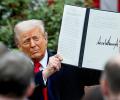
India is already negotiating a bilateral trade agreement with the US. The two countries are aiming to finalise the first phase of the pact by fall (September-October) of this year.
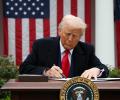
On India, the chart showed that the country charged 52 per cent tariffs on the US "including currency manipulation and trade barriers," and America will now charge India "discounted reciprocal tariffs" of 26 per cent.
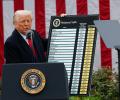
US President Donald Trump announced a 26 per cent "discounted reciprocal tariff" on India, half of the 52 per cent levies imposed by India on American goods, as he described India as "very, very tough."

'Right now, silver -- and especially platinum -- are very cheap compared to gold. If I were buying today, I would choose platinum.'

The rupee on Thursday plunged by a whopping 130 paise to hit life-time low of 60 against the US dollar in early trade on the Interbank Foreign Exchange on strong demand for the American currency from banks and importers

If Beijing succeeds in this multipronged effort to challenge the current dominant power, it will have not just economic but political and security consequences. There is no let-up in the South China Sea nor any de-escalation moves on the India-China border. This portends to ominous signalling from Beijing, observes China expert Srikanth Kondapalli.
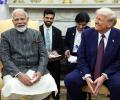
"Their Prime Minister just visited -- he's a great friend -- but I told him, 'You're not treating us right. You charge us 52%, while for years, decades even, we've c'harged you next to nothing. It wasn't until seven years ago, when I took office, that we started pushing back, beginning with China.'"

Wipro on Wednesday reported a 25.9 per cent year-on-year rise in consolidated net profit for the March quarter to Rs 3,569.6 crore, but warned of a weak quarter ahead with up to 3.5 per cent expected drop in IT services revenue for Q1FY26, amid global uncertainties. CEO and Managing Director Srini Pallia said clients remain cautious in the face of macroeconomic uncertainty.

The US involvement in Ukraine and the Middle East is a distraction which has to end quickly so that the main business of China can be focussed on. China is America's only peer competitor, not Russia and not anybody else. Therefore it makes little sense to be diverted from the overall mission, explains Aakar Patel.

President-elect Donald Trump's warning that BRICS countries will face 100 per cent tariffs if they choose to move away from the US dollar is unclear to what extent he will carry out his threat, as it remains to be seen if the US laws permit such an action, former RBI Governor Duvvuri Subbarao said on Monday. He also said even for BRICS, there are internal differences about bringing out an alternative to the US dollar.

'Entering India is exciting, but it's also challenging. You have to be prepared for long-term investment.'

The rupee depreciated 40 paise to an all-time low of 81.93 against the US dollar in early trade on Wednesday as the strengthening of the American currency and risk-averse sentiment among investors weighed on the local unit. Moreover, a negative trend in domestic equities and significant foreign fund outflows sapped investor appetite, forex traders said. At the interbank foreign exchange, the rupee opened at 81.90 against the greenback, then fell to 81.93, registering a fall of 40 paise over its previous closing.

Goods from sectors, including agriculture, precious stones, chemicals, pharma, medical devices, electricals, and machinery may get impacted if the US will go ahead with imposing reciprocal tariffs on Indian products, according to experts. They said that these sectors could face additional customs duties from the Trump administration because of the high tariff differential or gap, which is the difference between the import duties imposed by the US and India on a product.
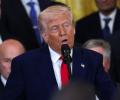
United States President Donald Trump on Sunday warned of new and significantly higher tariffs on Chinese goods if Beijing does not withdraw a recent 34 per cent retaliatory tariff hike, threatening to end all ongoing talks with China.

Weakness of dollar in the overseas market also boosted the rupee value against the dollar.
The rupee plunged 58 paise to close at an all-time low of 81.67 (provisional) against the US dollar on Monday as the strengthening of the American currency overseas and risk-averse sentiment among investors weighed on the local unit. Moreover, escalation of geopolitical risks due to conflict in Ukraine, a negative trend in domestic equities and significant foreign fund outflows sapped investor appetite, forex traders said. At the interbank foreign exchange market, the local currency opened at 81.47, then fell further to close at an all-time low of 81.67 against the American currency, registering a decline of 58 paise over its previous close.

Stock markets would be driven by global trends and foreign investors' trading activity in the holiday-shortened week, analysts said adding that key equity indices may face volatile trends amid the monthly derivatives expiry on Thursday. This week markets will have just three trading sessions. Equity markets will remain closed on Monday for Holi and on Friday for Good Friday. "This week will be shorter due to market closure on both Monday for Holi and Friday for Good Friday.
 © 2026 Rediff.com - Advertise with us - Disclaimer - Privacy Policy - Sitemap - Feedback - About us - Terms of use - Grievances